
Let’s be honest. If you’ve ever had an LED video wall fail during a sudden downpour at a music festival, or had a client complain that the screen looks completely washed out under the afternoon sun, you already know the stakes.
Buying rental LED panels isn’t like picking a TV for your living room. It’s a heavy capital investment. As an AV staging company or event production house, your screens are your money-makers. If they go down, your reputation goes down with them.
When you start searching for how to choose outdoor rental led screenoptions online, you’re usually bombarded with confusing spec sheets and suppliers claiming they have the “best quality at the lowest price.” But what does that actually mean?
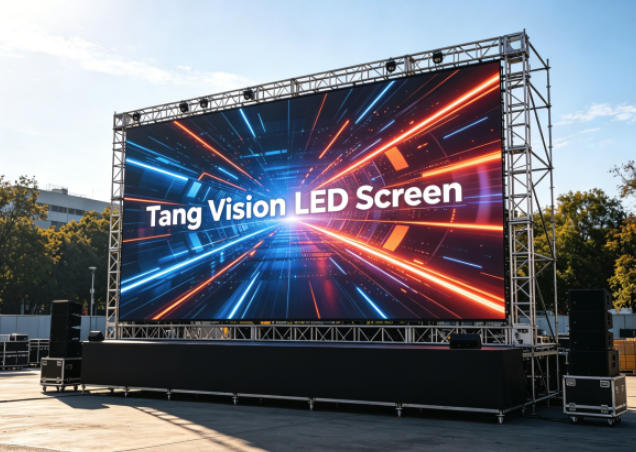
Having manufactured and exported LED displays for years, we’ve seen buyers make the same expensive mistakes over and over again. In this guide, we are going to cut through the marketing fluff. We’ll break down exactly what specs you need to care about, where you can save money, and where cutting corners will absolutely ruin your next gig.
1. Pixel Pitch: Stop Overpaying for Unnecessary Resolutions
The first question every buyer asks is, “What pixel pitch should I get?”
Pixel pitch (the “P” value, like P3.91 or P4.81) is simply the distance in millimeters between the center of one LED pixel and the next. The smaller the number, the higher the resolution—and the higher the price tag.
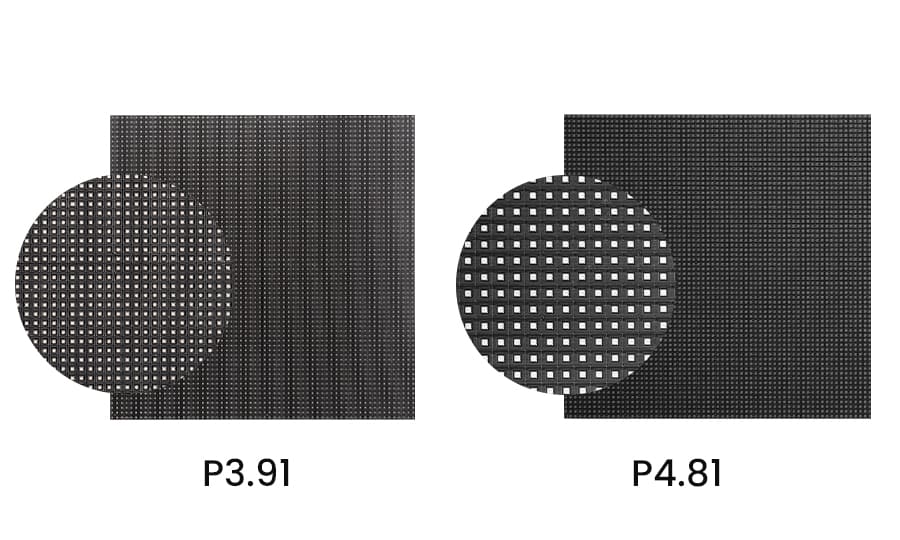
Many new buyers think they need the tightest pixel pitch possible to impress their clients. This is a fast way to burn your budget. In the outdoor event world, your audience is rarely standing two meters away from the screen.
The Golden Rule of Viewing Distance:
To figure out the minimum viewing distance (where the image looks smooth and not pixelated), simply convert the pixel pitch into meters.
- P3.91:Looks great from 4 meters (roughly 13 feet) away.
- P4.81:Looks great from 5 meters (roughly 16 feet) away.
The Two Heavyweights: P3.91 vs. P4.81
If you are buying outdoor rental screens right now, 90% of your choices will boil down to these two specs.
- Go with P3.91 if:You are doing a lot of corporate events, VIP outdoor weddings, or brand activations where the audience might walk up fairly close to the stage. It has become the industry standard for high-end outdoor rentals. (Check out our P3.91 Outdoor Rental LED Screenfor detailed specifications).
- Go with P4.81 if:You are building massive screens for music festivals, sports events, or large concerts. When the closest audience member is 20 feet away behind a security barricade, they literally cannot tell the difference between P3.91 and P4.81. But your bank account will feel the difference. P4.81 is cheaper, and the larger diodes often push out higher brightness.
Average Rental LED Display Price Range
The first thing to understand about LED video wall pricestructures is that manufacturers and suppliers calculate costs based on the price per square meter (sqm), rather than per individual cabinet.
| Application Category | Subcategory & Typical Pixel Pitch | Estimated Price Range (USD/sqm) |
|---|---|---|
| Indoor Events | High-Definition Conferences, Trade Shows (P2.6 / P2.97) | $1,200 – $2,500+ |
| Outdoor Events | Concerts, Festivals, Sports (Waterproof IP65 – P3.91 / P4.81) | $1,500 – $3,000+ |
| Creative Stage Designs | Curved, Transparent, or Custom Mesh Screens | Varies by design complexity |
Important Note:The lower end of these price ranges typically represents standard hardware configurations. The higher end accounts for premium, professional-grade upgrades that are often crucial for high-end staging—such as high refresh rates for flicker-free broadcasting, top-tier LED lamps, and ultra-lightweight die-cast aluminum cabinets.
2. Brightness is King (Don’t Let the Sun Wash You Out)
Indoor screens usually sit around 800 to 1,200 nits (cd/m²). If you take an indoor screen and put it outside at 2:00 PM on a sunny July afternoon, your screen will look like a piece of dark cardboard.
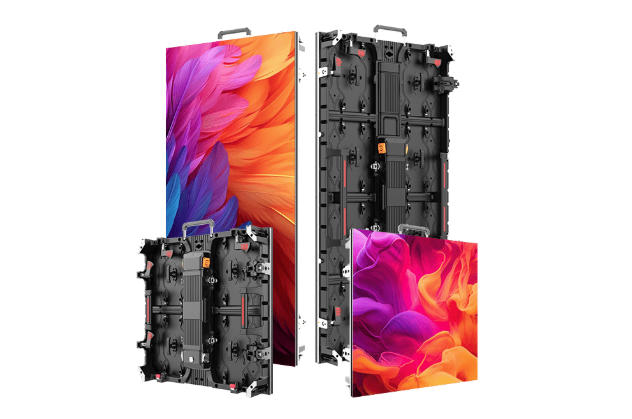
For a true outdoor rental LED screen, brightness is non-negotiable.
- The Bare Minimum:4,500 nits. This will get you by on cloudy days or under heavily shaded stage roofs.
- The Industry Standard:5,000 to 5,500 nits. This is what you should be aiming for. It competes well with direct ambient daylight.
- The Premium Tier:6,000+ nits. If your screens are facing direct west during sunset, you’ll need this level of output.
A quick pro-tip on brightness and lifespan: If you buy a 4,500-nit screen and run it at 100% brightness for every gig, the LED diodes will degrade much faster. If you buy a 5,500-nit screen and only run it at 80% capacity most of the time, the screen stays cooler, the power supplies aren’t stressed, and the lifespan of your video wall extends significantly.
3. Weather Resistance: Beyond the IP Rating
You already know an outdoor screen needs to be waterproof. But let’s talk about what “waterproof” actually means in the LED industry.
You will usually see a rating like IP65/IP54.
- The first number (IP65) is for the front of the screen. It means it is totally protected against dust and can handle low-pressure water jets from any direction (rain).
- The second number (IP54) is for the rear of the cabinet.
The Trap:Many buyers only look at the IP rating on paper. But weather resistance is highly mechanical. How good are the rubber gaskets sealing the modules to the cabinet? Are the power and data connectors genuine Seetronic or Neutrik, or are they cheap knock-offs that will short out after three uses in the rain? Are the internal PCB boards coated with anti-corrosion conformal coating (often called the “three-proof” paint)?
When you ask your supplier about weatherproofing, don’t just ask “Is it IP65?” Ask them to show you close-up photos of their module seals and cable connectors. That’s where water actually gets in.
4. Mechanical Design: Setup Time is Money
When you are paying a crew of riggers by the hour, every extra minute spent assembling a video wall eats into your profit margins. A rental screen is built to be assembled, torn down, thrown into a flight case, bumped in a truck, and put back together again. The mechanical design of the cabinet is just as critical as the electronic components.
Die-Cast Aluminum Cabinets
Never buy heavy iron cabinets for rental purposes. You need die-cast aluminum. It’s lightweight (usually around 12kg to 14kg for a standard 500x1000mm cabinet) and highly precise. Precision means that when you lock two cabinets together, there are no ugly dark lines or visible gaps between them.
Fast-Lock Systems and Ergonomics
Look at the locking mechanisms on the top and sides of the cabinet. Can a technician lock them with one hand while holding the panel with the other? Are there large, comfortable handles?
Front and Rear Maintenance
Imagine you have a massive 10×5 meter wall built, and a single module right in the middle dies. If your screen is rear-maintenance only, and there is a solid wall behind your stage, you are in big trouble. You want modules that can be popped out from the front using a magnetic tool, or unscrewed easily from the back. Flexibility saves the show.
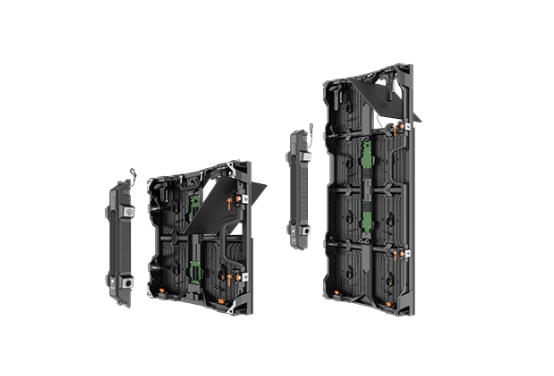
Edge Protection
LED diodes at the very edges and corners of the cabinets are incredibly vulnerable. One rough bump during setup, and you’ve knocked off three pixels. Modern, high-quality rental cabinets come with fold-out corner protectors or a slightly recessed design to shield the diodes when the panels are sitting on the ground.
5. Refresh Rate: Keep the Cameras and Sponsors Happy
Have you ever tried to take a photo of a digital screen with your phone, and the picture came out with horrible black scrolling lines? That’s caused by a low refresh rate.
For modern live events, weddings, and corporate gigs, everyone is pointing a camera at your stage. Even worse, if there is professional broadcasting or livestreaming involved, a screen with a low refresh rate will look terrible on camera, and your clients will be furious.
- 1920Hz (Standard):This used to be acceptable, but it’s rapidly becoming outdated. You might still get away with it for small, non-televised events, but we don’t recommend it.
- 3840Hz (High Refresh Rate):This is the current gold standard for rental LED displays. At 3840Hz, the screen looks buttery smooth to the naked eye, and it looks flawless through a camera lens, even at high shutter speeds.
How to verify this:The refresh rate is heavily dependent on the driving IC (Integrated Circuit) used on the circuit boards. When negotiating, explicitly ask your factory if they are using high-end ICs like the MBI5153 or ICN2153 to guarantee that 3840Hz performance.
6. The “Hidden” Internal Components
Two LED screens can look exactly identical on the outside, have the exact same cabinet design, and both claim to be “P3.91.” Yet, one costs $1,500 per square meter, and the other costs $2,500. Why? The secret lies under the hood.
The LED Lamps (The Diodes)
The little lights themselves are the most expensive part of the screen.
- Premium Tier:Nationstar (National Star) is widely recognized as the most reliable gold-wire or copper-wire LED package in China. They offer incredible color consistency and extremely low failure rates.
- Budget Tier:Kinglight or other smaller brands. They work fine for budget projects, but the color degradation over a few years is much faster.
Power Supplies
The power supply is the beating heart of the cabinet. Outdoor environments mean heat, humidity, and unstable generator power. Brands like MeanWell, G-Energy, or CZCL are reliable. A cheap, no-name power supply is a ticking time bomb.
Receiving Cards
This is the brain of the cabinet. NovaStar is the undisputed king of control systems in the LED world. Make sure your cabinets are equipped with genuine NovaStar receiving cards (like the A5s Plus). It makes calibration, troubleshooting, and software configuration a hundred times easier for your AV techs.
7. Don’t Forget the Transport and Accessories
When budgeting for your new outdoor LED wall, don’t blow all your money on the screen itself. You need to transport and hang it.
- Flight Cases:Cardboard or wooden crates won’t survive the rental business. You need heavy-duty flight cases with shock-absorbing foam inside and sturdy caster wheels.
- Hanging Bars (Rigging Bumpers):You need these custom-made steel bars to safely hang your screen from a truss. Always buy them directly from the manufacturer so they match the cabinet locks perfectly.
- Spare Parts:Always order at least 2% to 3% spare parts. This includes spare LED modules, receiving cards, power supplies, and data cables. If something breaks on a Saturday night gig, you cannot wait two weeks for a replacement part to ship from China.
Final Thoughts: How to Vet Your Supplier
Learning how to choose an outdoor rental led screen ultimately comes down to choosing the right partner. The B2B LED market is flooded with trading companies pretending to be factories, and they compete strictly on rock-bottom prices by secretly swapping out good components for cheap ones.
When you speak to a supplier, test them. Ask them about their aging test process (a good factory runs the screen white for 72 hours before shipping). Ask for a video call to see their assembly lines. Ask them specifically what IC drivers and LED lamps they use. A reliable manufacturer won’t just send you a cheap price list; they will ask you about your local climate, the type of events you produce, and your camera setup before recommending a product.
Looking to expand your rental inventory?
At Tang Vision, we don’t just build screens; we build reliable tools for staging professionals. From die-cast aluminum P3.91 to ultra-bright P4.81 festival screens, we manufacture everything in-house with total transparency on components.
Get a Direct Factory Quote Today
Planning a stage show, concert, or corporate event? Skip the middleman. Contact Tang-Vision’s engineering team today to get a complete hardware list and a competitive wholesale price query.