
In the stage rental and event production industry, choosing the right LED display involves one critical, head-scratching decision: selecting the perfect pixel pitch (the “P” value).
Pixel pitch directly determines your screen’s clarity, optimal viewing distance, and, most importantly, your initial investment cost and Return on Investment (ROI). Choosing the wrong pitch can either drain your budget unnecessarily or ruin a live performance with blurry, pixelated visuals that leave clients furious.
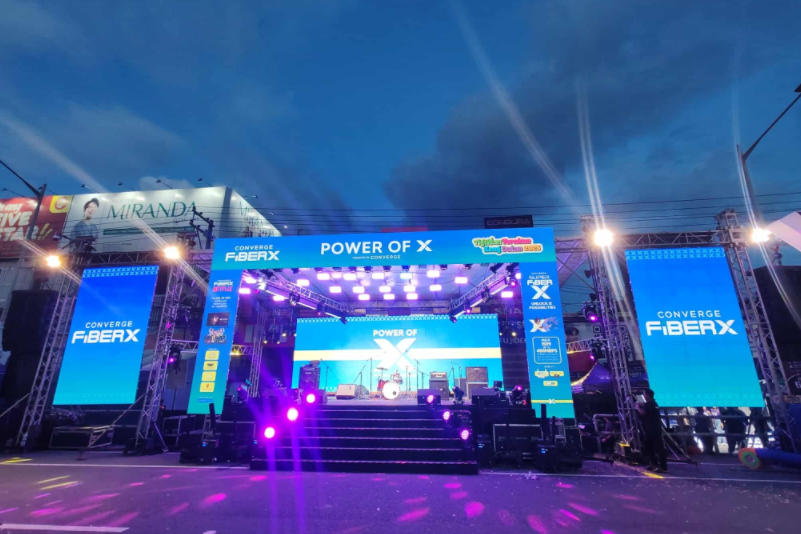
As an industry-leading factory brand specializing in premium stage displays, Tang Visionhas created this comprehensive guide to help you choose the perfect pixel pitch for your stage events like a seasoned pro.
1. What is Pixel Pitch?
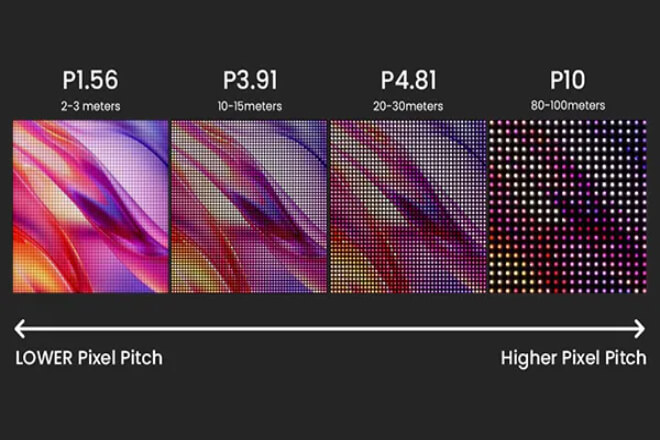
Pixel pitch—typically expressed with a “P” followed by a number (e.g., P2.6, P3.91)—refers to the distance in millimeters between the center of two adjacent LED pixels (diode clusters).
-
Smaller Pixel Pitch (e.g., P2.6):Higher pixel density, sharper images, and a much closer optimal viewing distance.
-
Larger Pixel Pitch (e.g., P4.81):Lower pixel density, more noticeable pixelation up close, but higher brightness and robust weather resistance, making it ideal for distant viewing.
2. The Big Three: Mainstream Pixel Pitches in the Rental Market
In the global AV rental and stage design market, three golden pixel pitches dominate over 90% of all event projects:
P2.6 — The Premium Choice for Indoor High-Definition Stages
P2.6 (2.6mm pitch) is currently the reigning king of high-end indoor rentals.
-
Optimal Viewing Distance:2.5 meters to 5 meters.
-
Core Applications:Corporate annual meetings, luxury product launches, television studios, theaters, and XR virtual production stages.
-
Why Choose It:At close range, front-row VIP guests cannot see any pixelation. Crucially, when captured by professional broadcasting cameras, a high-refresh P2.6 screen eliminates the Moiré effect (flickering scanning lines), making it the top pick for live streaming and recording.
P3.91 — The Universal King of Cost-Effectiveness (Indoor & Outdoor)
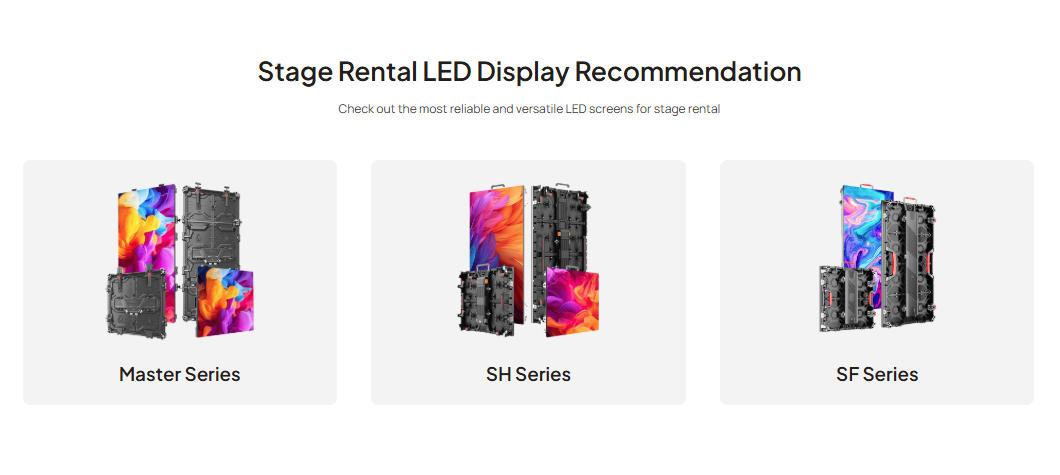
If your rental company is starting out and can only afford to invest in one type of screen, go with P3.91 (such as Tang Vision’s Master, SF, or SH Series).
-
Optimal Viewing Distance:4 meters to 10 meters.
-
Core Applications:Mid-to-large music festivals, main stage backdrops, trade show booths, weddings, and parties.
-
Why Choose It:It is the most mature, mass-produced, and cost-effectivemodel in the entire LED industry. Balancing crisp resolution with extreme stability, it can act as a high-definition indoor backdrop or be configured as a high-brightness outdoor powerhouse for massive roadshows.
P4.81 — The Heavy-Duty Choice for Large Outdoor Concerts
For open-air concerts attracting thousands of attendees, P4.81 is the most dominant and reliable selection.
-
Optimal Viewing Distance:5 meters to 20+ meters.
-
Core Applications:Stadium concerts, massive outdoor EDM festivals, and large-scale outdoor side screens (IMAG).
-
Why Choose It:In giant outdoor arenas, the audience stands dozens of meters away. From that distance, the human eye naturally blends the pixels together, making the imagery look massive and spectacular. Furthermore, P4.81 allows for larger LED chips, delivering higher brightness (usually >4500 nits)and exceptional heat dissipation to withstand harsh weather.

3. The 3 Golden Mathematics Formulas for Stage LED Setup
When selecting your pixel pitch, don’t guess. You can calculate your needs using these three standard industry formulas:
Formula 1: Best Viewing Distance (BVD)
$$\text{Best Viewing Distance (m)} \approx \text{Pixel Pitch (mm)} \times 1 \sim 1.5$$
-
Example:If you purchase a P2.6screen, the front-row audience should sit roughly $2.6 \times 1 = 2.6\text{ meters}$away to experience the most flawless visual immersion.
Formula 2: Minimum Viewing Distance (MVD)
$$\text{Minimum Viewing Distance (m)} \approx \text{Pixel Pitch (mm)} \times 1$$
-
If the audience stands closer than this calculated distance, they will start noticing individual red, green, and blue LED diodes.
Formula 3: Meeting Resolution Requirements (HD or 4K)
Event planners frequently demand that a stage backdrop meet Full HD ($1920 \times 1080$) or 4K resolution standards.
-
With a P2.6screen, achieving a width of 1920 pixels requires a screen length of only about 5 meters.
-
With a P4.81screen, achieving that same 1920-pixel width requires a screen length of nearly 9.2 meters.
-
The Rule of Thumb:The smaller the physical stage, the smaller the pixel pitch you need. If the stage footprint is massive, larger pitches can easily stack up to hit high-resolution requirements.
4. Crucial Pitfalls Every Rental Buyer Must Avoid
B2B buyers should never look at the pixel pitch number alone. You must evaluate these hidden structural factors that directly impact your rental operational costs:
-
Durable Cabinet Craftsmanship (Seamless Splicing):
A perfect pixel pitch requires flawless mechanical engineering. You must choose high-precision die-cast aluminum cabinetspaired with robust quick locks. If the cabinet panels don’t align perfectly, even a P2.6 screen will display ugly black or white lines across the joints, ruining the visual illusion.
-
Transport Damage & Fragility (Reliability):
The smaller the pixel pitch (like P2.1 or P1.9), the more fragile the LED diodes become. Stage rental gear requires daily teardowns, loading, and bumpy truck transport. Ultrafine pitches are highly prone to “dead pixels” during rough handling. In the rental market, P2.6 and P3.91 represent the absolute sweet spot between structural durability and image sharpness.
-
Refresh Rate & Camera Friendliness:
Stage screens must feature a high refresh rate of 3840Hz or higher. If you cut corners with a cheaper 1920Hz driver IC to save a few dollars, smartphone photos taken by attendees or video feeds recorded by media cameras will show horrific dark bands, instantly tanking your event’s reputation.
Final Thoughts
There is no single “best” pixel pitch for every stage rental LED screen project. The ideal choice depends on viewing distance, event type, screen size, and budget.
For most indoor rental applications, P2.6 and P2.97 offer an excellent balance between image quality and investment. For outdoor concerts and festivals, P3.91 continues to be the industry standard due to its versatility and cost efficiency.
Before selecting a rental LED screen, work with an experienced manufacturer that can evaluate your venue and recommend the most suitable solution. A properly chosen pixel pitch not only improves audience experience but also maximizes the value of your investment.
Conclusion: Tang Vision’s Ultimate Recommendation
-
If your primary business is indoor corporate galas, premium product launches, and luxury exhibition booths:Prioritize investing in a P2.6 Indoor Rental Seriesto capture high-budget corporate clients who demand flawless close-up visuals.
-
If you manage a wide variety of events, from indoor weddings to outdoor roadshows:Choose the P3.91 Indoor/Outdoor Dual-Use Series. It is the ultimate “cash cow” with the fastest payback period in the rental industry.
-
If you specialize in music festivals, stadium concerts, and open-air public events:Go with a P4.81 Outdoor High-Brightness Series (such as our SH or SF Series). Ruggedness, high daylight visibility, and IP65 waterproofing are what truly matter under the open sky.
Need a Professional Stage LED Display Quote?
Tang Visionis a direct manufacturer of high-performance stage LED displays. Our premium Master Flagship Series, SH/SF Outdoor Series, and SH-C Creative Flexible Seriescover all golden pixel pitches from P2.6 to P4.81. Contact our technical engineering team today to receive a free stage layout design and exclusive direct-factory wholesale pricing!
FAQ for Stage Rental LED Screens
How do I choose between indoor and outdoor rental LED screens regarding pixel pitch?
A:Indoor stages usually require a smaller pixel pitch (P2.6 or P2.9) because the audience sits much closer (within 2–5 meters), demanding higher resolution and camera-friendly performance. Outdoor stages have a farther viewing distance, making larger pitches (P3.91 or P4.81) the standard. More importantly, outdoor screens require IP65 waterproofingand much higher brightness (>4,500 nitscompared to 800–1,200 nits for indoor) to fight direct sunlight.
Why is a 3840Hz high refresh rate critical for stage LED displays?
A:A low refresh rate (like 1920Hz) creates ugly dark scanning lines and flickering when people take photos with smartphones or when professional media cameras broadcast the event. A 3840Hz high refresh rateensures a flawless, flicker-free visual experience both live on-stage and on-camera, which is a strict requirement for modern corporate events, concerts, and live streaming.
What is the Moiré effect, and how does pixel pitch affect it?
A:The Moiré effect is that geometric, wavy distortion pattern that appears on TV or video when a camera films an LED screen. It happens when the camera’s sensor resolution doesn’t match the LED screen’s pixel layout. Choosing a finer pixel pitch like P2.6and maintaining the correct Best Viewing Distance ($BVD \approx \text{Pitch} \times 1 \sim 1.5$)drastically reduces or eliminates the Moiré effect for broadcasting.
Can I mix different pixel pitch cabinets together on the same stage setup?
A:Mechanically, it depends on the cabinet design. If they share the same physical framework (e.g., Tang Vision’s universal rental cabinet design), you can physically lock them together. However, system-wise, it is not recommended for a seamless main walldue to different resolutions, brightness, and color calibrations. A common industry practice is using a fine pitch (P2.6) for the center main backdrop and a larger pitch (P3.91 or P4.81) for distant side IMAG screens to optimize your budget.